
Serving, educating and representing lay people in the Church
Unfinished business from the Second Vatican Council

“Educate, serve and represent” was one of Cardijn’s most famous trilogies. It was based on what theologians have labeled the “tria munera,” namely Christ’s “three roles” as prophet, king and priest, in which Christians share by virtue of their baptism.
For Cardijn, this was also linked to his understanding of Catholic Action, as he wrote in 1957:
There is much discussion today about the distinction between Catholic action, Catholic apostolate, and Catholic Action. I believe the latter is the school, the service, and the representative body of the former.
Cardijn often drew on his educate, serve, represent trilogy to characterise the role of the YCW and young workers in educating, serving and representing their fellow young workers.
As the famous YCW pilgrimage to Rome in August 1957 by 32,000 young workers illustrated, this included the need for the movement to “represent” young workers not just outside but also within the Church.
And so it’s completely unsurprising that when, during the 1950s, Cardijn began to advocate for a Roman lay apostolate body he also viewed this as a body that would represent lay people within the Church in their dialogue and partnership with the hierarchy.
See, for example, this proposal (the source of the above quote) that he submitted to Pope Pius XII just prior to the Second World Congress on Lay Apostolate, which took place in Rome in October only a few weeks after the YCW pilgrimage:
https://wcla.apostolicamactuositatem.org/cardijn-lay-people-in-the-church/
Vatican II
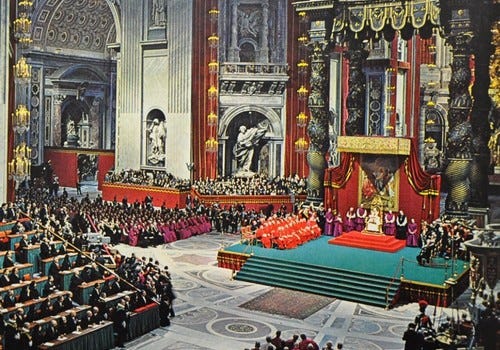
He continued in the same line during the Second Vatican Council, lobbying consistently for a post-conciliar lay apostolate body with representation from lay people and lay movements.
Here is one of his most developed formulations of that proposal:
https://josephcardijn.com/en/item/90
As Cardijn wrote on that occasion,
It is not to be the Secretariat of the Hierarchy for controlling or supervising the laity but it should much more be (a) a secretariat of the laity for the Hierarchy, and (b) a secretariat of the laity in view of collaboration with other institutions and organisations outside the Church.
Marguerite Fiévez, founding secretary of the International YCW, who was working with Cardijn during the Second Vatican Council, also developed an important proposal for a three-part structure comprising a “pontifical commission,” an “advisory body” and a “central secretariat.”
https://wcla.apostolicamactuositatem.org/1964-01-01-fievez-proposal-for-a-roman-organisation/
In Fievez’s view, the advisory body needed to be representative of lay people and lay movements:
Having a representative and democratic character, like a kind of parliament, it would bring together the needs, aspirations, and experiences of the grassroots. It would meet every two years and give advice on the general orientations of the lay apostolate in response to the needs of the moment.
The International YCW and its sister movements also advocated for a similarly representative post-conciliar body, e.g. here:
https://synodality.josephcardijn.com/1964-proposal/
See also:
https://synodality.cardijnresearch.org/a-representative-vatican-body-for-laity/
Moreover, their advocacy was successful with the Vatican II Decree on Lay Apostolate, Apostolicam Actuositatem, adopted in November 1965, reflecting their desire for a representative body in which lay movements “would have a part” – “partes habeant” in the Latin text – i.e. play a role. In fact, the English translation on the Vatican website explicitly translates this using the term “represented,” emphasising that “the various movements and projects of the apostolate of the laity throughout the world should also be represented in this secretariat” (§26).
Sadly, as we now know and as I have previously recorded, the post-conciliar body established by Paul VI in 1967, i.e. the Consilium de Laicis did not incorporate this representative character.
Cardijn was deeply distressed by this, sending an extremely strong response to the pope expressing his disappointment and frustration:
https://synodality.cardijnresearch.org/cardijns-devastating-critique/
As he wrote, the new Consilium de Laicis “gives the impression of a highly overbearing tutelage that will weigh down on the laity, their responsibility and their apostolic action.”
The movements themselves also opposed the new Consilium de Laicis structure as this document below also shows:
https://synodality.cardijnresearch.org/an-alternative-model-for-a-vatican-council-of-the-laity/
Third World Congress on Lay Apostolate 1967
What’s more this issue also became a topic of concern at the Third World Congress on Lay Apostolate held in October 1967.
Indeed, the US delegation there proposed a draft resolution explicitly calling on Pope Paul to change the structure of the new Council:
That the organizational structure of the Council of the Laity established by his holiness Pope Paul VI be changed so as to create a body truly representative of the laity and for the free election of its officers and members by the laity.
And it also called for similar representative bodies at every level of the Church:
That councils of the laity should be established at all national, diocesan, and parish levels and that such councils be truly representative of the laity and their officers and members be freely elected by the laity.
Several international Specialised Catholic Action movements including the International YCW, the International YCS and the FIMARC (an international Catholic rural movement) and others also submitted a similar draft resolution:
Taking into account that the lay council is constituted experimentally, the Congress wishes that qualified representatives of the various regions of the world and the different families of apostolate should have their place in the lay council.
The Congress also wishes that these representatives can be elected democratically inside the various structures of the world’s regions and international organizations, having in mind:
The social milieu (workers, rural, independent)
Ages (children, youth, adults)
Sexes
Frankly, this is a striking rejection of the structure of the newly formed Consilium de Laicis just months after its constitution by Pope Paul VI.
Unfinished business
Sadly, all of this advocacy was all to no avail. Successive iterations of the Vatican body for laity have only become more clerical:
https://synodality.cardijnresearch.org/the-clericalisation-of-the-dicastery-for-laity/
The original Consilium de Laicis became the Pontifical Council for the Laity in 1976 followed by the present instance, i.e. the Dicastery for Laity, Family and Life.
Thus, in what amounts to unfinished business of Vatican II, the call in Apostolicam Actuositatem §26 for a “representative” secretariat in which the lay movements will have a part or a role has never been acted upon.
Next year, 2027, will be the 60th anniversary of Cardijn’s death, as well as the 60th anniversary of the Third World Congress on Lay Apostolate and of the Dicastery for Laity, Family and Life.
As Pope Leo XIV – like Pope Francis – has consistently insisted, Vatican II remains a fundamental reference for the Church today.
2027 thus offers a perfect opportunity to reflect on how the Church can go further in implementing the Vatican II vision of a Holy See body to promote the lay apostolate, by educating, serving and representing lay people in the Church.
Stefan Gigacz