
Blackclad in a Roman heatwave
Be like Jesus or the pope! Wear white!

At 8.30 this morning, I saw an older-looking Italian bishop dressed in black walking down the hill towards the Vatican. His face was already red in the rising heat of a day that’s going to be around 37°C.
Suddenly, I was reminded of the nuns at my childhood primary school sweating through the summer red-faced in their dark, heavy habits. But I also remember their joy when the Second Vatican Council reforms allowed them to switch to wearing white in the hot Australian summer.
Here in Rome, though, sixty years later, every day I see black-clad bishops and priests walking near St Peter’s presumably on their way to work or an official function.
Frankly, if my children wanted to dress in all black under the sun in such weather, I would stop them, warning them of the risks of sunstroke, heatstroke, etc.
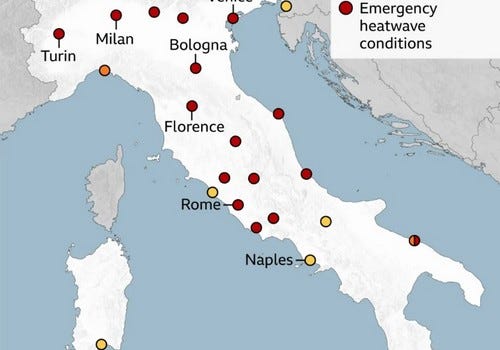
Indeed, the Italian Ministry of Health explicitly warned that Rome is facing “emergency heat wave conditions” this week.
https://www.bbc.com/news/articles/c78y4102n1zo
So why are bishops (mostly aged 60 or more) and priests, who should be giving good example to their flock, continuing to wear black?
If Australian sisters could change the after the Council, why not priests and bishops?
As it turns out, it seems many of them did change or try to do so – until Pope Benedict cracked down on the practice in 2012.
Here is the text of the actual circular sent out by Cardinal Tarcisio Bertone calling them to order:
https://www.newliturgicalmovement.org/2012/11/clerical-dress-in-vatican.html
Well, no doubt Pope Benedict was doing his best to reign in what he regarded as a lack of clerical discipline.
But how is obliging priests to wear black in the middle of a heatwave preaching the Gospel?
In his new encyclical, Magnifica Humanitas, Pope Leo explicitly recognises that we are living in a period of “climate change”, “environmental disaster” and “climate crisis.”
Here in Rome in June 2026, we can feel it on a daily basis.
So why keep forcing priests, bishops, and even religious whose formal attire is still black, to continue to do so?
As it turns out, the historical reasons for the practice are relatively recent. One was the post-Reformation desire to emphasise the distinction between clergy and laity.
Another, it seems, was the fact that black and dark grey dyes were cheap or at least cheaper than other colours.
Then, in the 19th century, a certain style of clerical dress became standardised and globalised.
Apparently, wearing black also symbolised “dying to the world” in contrast to the white clerical collar evoking resurrection.
Well, as far as I can tell, wearing clerical black in the sun in close to 40° heat not just symbolises but may also risk the health or even the death of the suffering clergy.
According to Google Gemini:
Black fabric absorbs up to 90% of the solar radiation hitting it. At 37°C —which happens to be standard human core body temperature—that absorbed solar energy quickly turns into heat, making the fabric itself incredibly hot and warming you up from the outside.
On the other hand:
White fabric reflects the sun’s incoming visible light and radiant heat away from your body.
Wear white (or at least light colours) is the advice I would give to my own children – and as most tourists near St Peter’s do. And if they persisted in dressing in black under the hot sun, I would simply tell them: “Don’t be so dumb!”
Instead, let’s try to be more like Jesus the Mediterranean, who, according to most depictions, mostly wore white - as does his vicar Pope Leo XIV.
Stefan Gigacz