

The final reports from the various Synodal Study Groups have now started to appear. So perhaps it’s time to look again at various issues that have been raised.
Thus, reading the final report of the Study Group on “To hear the cry of the poor and the earth,” I was struck – and heartened – to see the number of references – 92, in fact – to the need for “formation,” a theme that has recurred throughout the whole process of the Synod on Synodality as well as during the Australian Plenary Council.
On the other hand, searching the text of the document, I was further struck by the lack of a single reference to any Vatican II document.
Actually, three Vatican II documents deal in detail with education formation. Gravissimum Educationis deals with school and university education while Optatam Totius specifically addresses the formation of priests.
The third document, Apostolicam Actuositatem, i.e. the Decree on Lay Apostolate, devotes the whole of its Chapter VI to the topic of forming lay people for their lay apostolate.
Well, no one ever said that Vatican II was the last word on formation. But it is more than surprising to see that a Synodal study group would fail to reference what it does say on the subject, particularly since both Pope Francis and Pope Leo have insisted that the Council is the foundation for a synodal Church.
All of which reminded me of the longstanding impression that I have had Apostolicam Actuositatem is the least studied and most ignored document of the Council.
And so I decided to check how well-founded that impression was. This I was able to with the help of Google’s Ngram viewer, which charts the frequency with which a word or phrase appears in books published over the course of time.
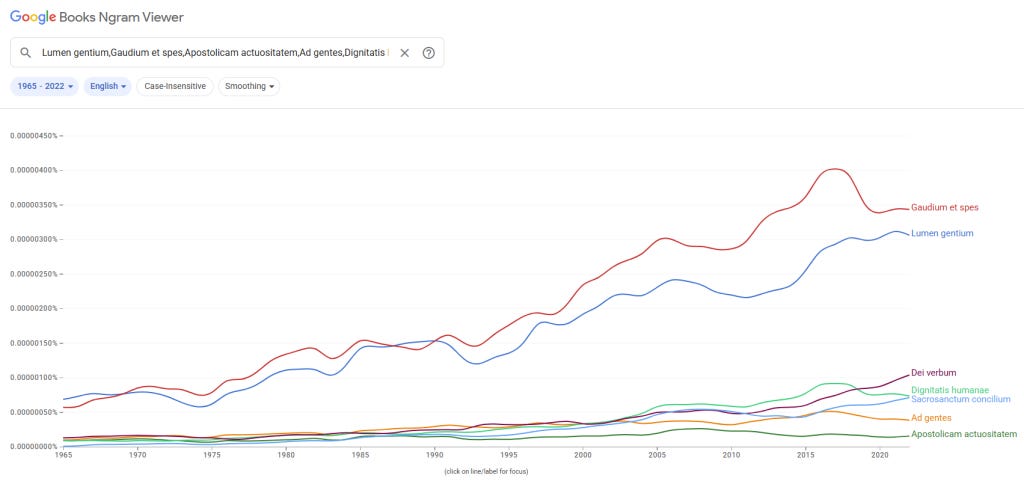
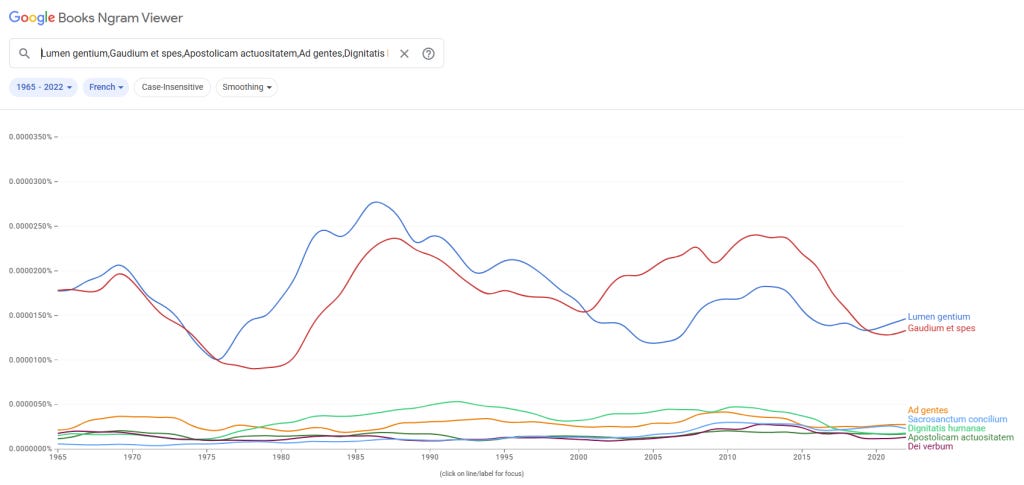
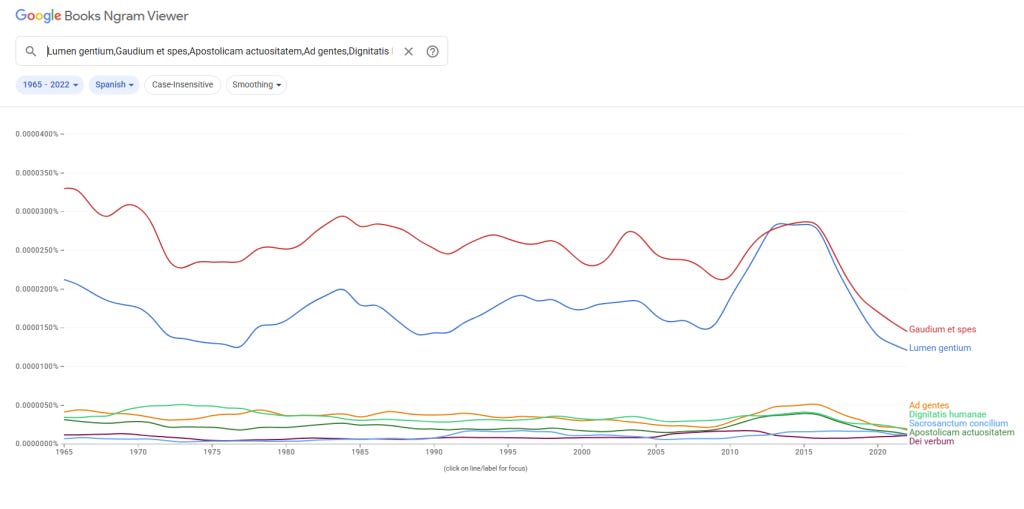
Thus, I was able to compare the number of published references to the titles of various Vatican II documents, namely Lumen Gentium, Sacrosanctum Concilium, Dei Verbum, Ad Gentes, Dignitatis Humanae and Apostolicam Actuositatem, for the period from 1965 until 2022. And I did so in English, French and Spanish
Here are the results:
English
Click here for a better view: https://books.google.com/ngrams/graph?content=Lumen+gentium%2CGaudium+et+spes%2CApostolicam+actuositatem%2CAd+gentes%2CDignitatis+humanae%2CDei+verbum%2CSacrosanctum+concilium&year_start=1965&year_end=2022&corpus=en&smoothing=3
French
Click here for a better view: https://books.google.com/ngrams/graph?content=Lumen+gentium%2CGaudium+et+spes%2CApostolicam+actuositatem%2CAd+gentes%2CDignitatis+humanae%2CDei+verbum%2CSacrosanctum+concilium&year_start=1965&year_end=2022&corpus=fr&smoothing=3
Spanish
Click here for a better view: https://books.google.com/ngrams/graph?content=Lumen+gentium%2CGaudium+et+spes%2CApostolicam+actuositatem%2CAd+gentes%2CDignitatis+humanae%2CDei+verbum%2CSacrosanctum+concilium&year_start=1965&year_end=2022&corpus=es&smoothing=3
Given their status as constitutions, it’s no surprise that Lumen Gentium and Gaudium et Spes head the frequency list in all three languages – and by a long way.
At the other end, Apostolicam Actuositatem brings up the rear in English, well below even the other conciliar declarations and decrees. The story is similar in French and Spanish, albeit surprisingly it just beats out Dei Verbum on Divine Revelation.
Sadly, this seems to confirm my hypothesis that Apostolicam Actuositatem, the Decree on the Lay Apostolate, is the least read and no doubt the least studied of all the major Vatican II documents.
Yet, as Pope Leo reminded us in his General Audience this week, “lay people are, put simply, the vast majority of the people of God.” In this context, the failure of the Synodality Study Group on the cry of the poor and the earth to reference Apostolicam Actuositatem is frankly astonishing.
If – as the Synod on Synodality and the Australian Plenary Council affirmed -formation is a critical issue for the development of a synodal Church, is it not also time to look again at the Vatican II teaching in Apostolicam Actuositatem on formation for the lay apostolate?
Fortunately, Pope Leo has also signalled that in one of his future catecheses he will do just that.
Stefan Gigacz
I am hopeful that Pope Leo will develop the Theology of the Laiity in his catechesis of Vatican II. And Apostolicam Actuositatem is one of my "go to" docs
The theology of the laity flows from our understanding of ecclesiology, with a focus on the sacraments of baptism, confirmation, and the Eucharist in considering the membership, which is why in the early church and in the Eastern Rites, the three are given at once, even to infants. Then we need to acknowledge our functions, rights, duties, and mission of the faithful. The Second Vatican Council was unprecedented in its reflection upon and articulation of the identity, role, and spirituality of the laity in the Church and in the world. And always remember these words:
“God is using us; God needs us to accomplish the work; this is a great joy. Without our help, God cannot bring about the miracle that God intends to affect each one of us; through us but not without us.” ~ Louis J Putz CSC